
What’s the coolest thing you’ve ever found (and kept)?
The coolest thing I’ve ever found—and kept—is something far older and wiser than me. It’s not a rare coin or a piece of jewelry. It’s a fragile, faded piece of nature: an old palm leaf with writing on it.
Today, it might look like a museum curiosity, but once upon a time, this was someone’s “page.”
Before the widespread availability of paper, knowledge in many parts of the world was etched onto dried palm leaves. This wasn’t merely a tradition; it was a necessity born of scarcity. The palm leaf, prepared and inscribed with a sharp metal stylus, became the durable medium for preserving texts.
These leaves carried everything: from complex philosophical texts and vibrant poetry to the guarded formulas of ancient medicinal secrets. Each one was a vital, enduring piece of a larger, collective archive.
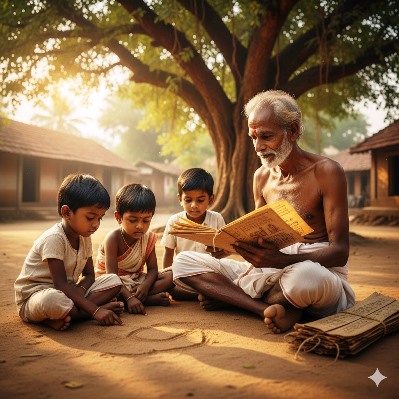
When I held this rediscovered leaf recently, a wave of profound nostalgia swept over me. It reminded me instantly of my first pre-school teacher (Ashaan).
This wasn’t an official school; it was an informal, community-driven act of education. Any one who knew reading and writing (Ashaan /teacher) took on the crucial role of teaching the first alphabets and numbers. It was their individual business at home or anywhere in a small room, no approval or registration needed from the Government.
Ashaan was the custodian of this written knowledge, teaching us from the essential, durable source: the palm leaf book. For us children, paper was simply not easily available and, more importantly, not needed for pre-primary learning.
Instead of paper, our canvas was the ground itself. We learned by drawing the letters and numbers out with our fingers in the smooth, cool sand. Ashaan’s palm leaf was the irreplaceable source—the memory of the lesson preserved—while the sand allowed for endless, free practice. The gentle, dry rustle of his leaves being turned was the actual sound of core knowledge being transferred.
Palm leaves were the original long-term storage. Traditional practitioners, like Ayurveda doctors, relied on vast bundles of these leaves to preserve their generational remedies and diagnostic methods. They ensured the wisdom endured, passed from master to student.
Tucked away in the back of my cupboard among old documents, I stumbled upon a single, small palm leaf. The moment I held it, I wasn’t just holding a fragile piece of fibre; I was holding a piece of time itself. It felt delicate, sacred, and absolutely full of stories untold—a whisper from an age when knowledge grew on trees and was shared freely on the ground.
In a world dominated by glowing screens, ephemeral digital files, and constant notifications, that little palm leaf rests now in a special, preserved spot. It serves as my quiet, powerful reminder of where our written words once began, and how the earliest act of learning was a beautiful, resourceful blend of communal teaching and grounded practice.

 Grandma’s Holistic Wellness