
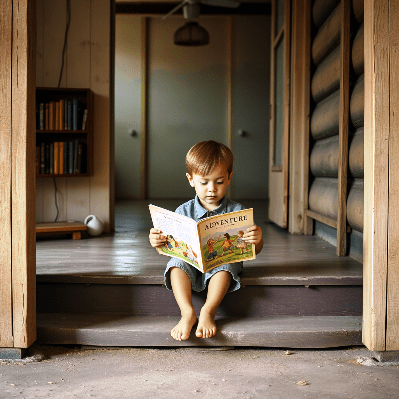
Growing up, books were like distant stars—visible in stories, perhaps, but far beyond reach. In my childhood, there were no libraries to walk into, no bedtime stories to fall asleep to, no colorful covers to pick from a shelf. Even the Bible, the one book so central to many, was kept under lock and key—literally. It stayed inside the church, reserved only for the priests. Ordinary people like me weren’t even permitted to touch it, let alone read it.
The only books we ever had access to were school textbooks—dry, functional, and read only for exams, not enjoyment. Stories, imagination, and the joy of reading? That world was closed off to us.
So for a long time, I didn’t know what it was like to read a book for the sheer joy of it. I didn’t know the weight of a story in your hands or the way a character could live in your head long after the last page. Books beyond the classroom were not just unavailable—they were unimaginable.
That changed in 7th grade.
It was a worn-out comic strip, barely 10 pages long, passed hand to hand like treasure among a few of us in school. It was about Phantom—the Ghost Who Walks. I didn’t know who he was, or what adventures waited inside. But the moment I opened it, something shifted.
Those black-and-white panels were alive. There was mystery, danger, courage, and something more: freedom. Not the freedom of the hero, but mine. I was free to imagine, to explore, to escape.
I don’t remember how many times I read that comic—it might have been twenty, maybe fifty. I do remember how I felt every time I turned those pages. It was like discovering a world no one had told me existed, and realizing it had been waiting for me all along.
That comic wasn’t just a story. It was a door. And once it opened, there was no going back.

 Grandma’s Holistic Wellness