


Have you ever broken a bone?
Yes, of course. Not just one bone, but several—thanks to a major road accident I had while riding a scooter. That incident involved multiple fractures, surgeries, and even the insertion of metal rods. I’ve written about that experience in several blog posts before. But today, I want to go further back—back to a time when life was simpler, when there were no scooters, no highways, and certainly no hospitals nearby. This is a story from my childhood, when I broke a bone not in a high-speed crash, but during a carefree moment of play in the dusty backyard of my school.
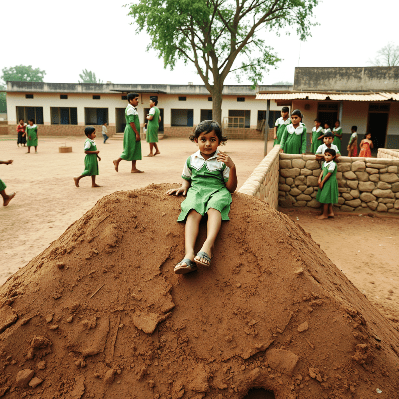
I was in the first grade at the time. Our school didn’t have slides, seesaws, or merry-go-rounds like the ones children enjoy today. Everything we played with came from the earth—sticks, stones, mud, and leaves. The backyard of our school was large and open, with a big mud heap off to one side. It wasn’t something the school had built for us. Most likely, it was leftover earth dumped there when the ground had been leveled, but over the years it had hardened and taken shape. For us, it was the ultimate slide. About 20 feet high, it felt like a mountain to our little legs. We’d scramble to the top and run or slide down again and again until our green and white uniforms looked more like brown camouflage.
One afternoon during our lunch break, we were playing our usual games, taking turns sliding down the slope. I had climbed to the top and was about to slide down when one of my classmates tugged at the edge of my dress. That unexpected pull threw me off balance. I fell and tumbled all the way down the slope, landing hard at the bottom. I lay there for a moment, dazed and covered in mud. My friends helped me up, and we quickly tried to scrub the dirt off before the bell rang.
Back in class, I began to feel a sharp pain in my left shoulder. Something didn’t feel right. As luck would have it, the next class was math, and we were to do a dictation on slate. In those days, we had no desks—just benches. Two students would stand facing each other, balancing a slate on the left shoulder while writing with a stone pencil in the right hand. I tried to lift my arm, but I couldn’t. The pain was too much. I told the teacher I couldn’t hold the slate, but he wasn’t sympathetic. Back then, we were taught to fear and obey our teachers, especially the male ones. Without a second thought, he scolded me and told me to get on with it. So, I did the best I could—kneeling on the floor, using the bench to support the slate, and somehow managed to write.
When the final bell rang, I started the long walk home—three kilometers of silence and growing pain. Usually, I’d come home chattering away, full of stories. But that day, I was quiet. When I reached home, I dropped my school bag and walked straight to the kitchen where my mother and sisters were preparing dinner. I stood at the door, not saying a word. My sister noticed something was wrong and asked me what had happened. I told her it was just the vaccination we’d had at school that day—it was hurting, that’s all. The shot had been in the same shoulder, so I thought the pain was from that.
But my sister noticed a small bruise near my elbow with a bit of dried blood. “Did you fall?” she asked. I nodded. She came closer and gently touched my arm—and I screamed. That’s when my mother came over, checked my shoulder, and suspected a fracture.
Without wasting time, she told me to come along, and we began walking another two kilometers to reach my father in the shop. We didn’t have any vehicles, and walking long distances was just part of daily life. My mother hadn’t thought to bring a torch from home, but when we reached the shop, we borrowed one from a friendly shopkeeper. We needed it—by then, the sun had set and the village was dark. There were no electricity or streetlights in the village, just the faint beam of the torch guiding us along narrow, uneven paths.
Eventually, we reached the home of the country practitioner, located near a field on the outskirts of the village. His house was lit with soft, flickering kerosene lamps, casting a warm but dim glow. The air smelled of herbs and damp earth. All around his home were medicinal plants—grown by him, tended with care, and used for healing the village folk.
He gently examined my shoulder and confirmed my mother’s suspicion—it was indeed fractured. He went out into his garden with the torchlight, collected a few leaves, ground them into a thick green paste, and made a cloth ball. He placed it under my arm and carefully wrapped it with layers of cloth to keep everything stable. Then he made a sling from another piece of cloth—rough and simple—and looped it around my neck to support my arm. I couldn’t move my shoulder at all, and the pain throbbed with every tiny shift.
That night, I couldn’t sleep in bed as usual. I had to sleep sitting up in an armchair, my body held in place by cloth and discomfort. The next few weeks passed slowly. I stayed home from school for a full month. There were no phones, no messages, and our house was far from others. It was quiet and a little lonely, but it gave me time to rest.
Every other day, the practitioner would walk all the way to my house to massage my shoulder. It hurt—a lot. I dreaded those visits. My mother knew how to bribe me, though. She’d boil eggs—my favorite back then—and place them in front of me just as the practitioner began his work. I’d focus on eating the eggs, and before I knew it, the painful massage would be over.
Eventually, the day came when the bandage and sling were removed. My shoulder was still tender, but it was healing. Slowly, I returned to normal life, back to the classroom, back to the mud slide, though perhaps a little more cautious.
That fall, that broken shoulder, taught me something that even the later scooter accident didn’t: resilience begins young. We didn’t have much, but we had our ways—simple, earthy, traditional. And sometimes, a boiled egg and a mother’s patience were all the medicine a child really needed.

 Grandma’s Holistic Wellness